
Fundamental Analysis — Beginner to Expert · Part 13 of 37
Goodwill, exceptional items and other income: three lines that arrive with an acquisition
The deal
On 1 October 2025, Desi Bites Foods bought Chatpata Foods (fictional regional namkeen brand) for ₹600 lakh in cash, paid out of the money raised in its June 2025 IPO. It was the company’s first acquisition, and it did three things to the accounts that hadn’t been there before: it put goodwill on the balance sheet, it produced an exceptional item on the P&L, and — together with the interest earned on the IPO cash — it made other income a line big enough to matter.
All three are places where a reader who knows only the ratios from the first module will be misled. This post is about reading them. (Fictional company, fictional deal; the accounting is real.)
Where the ₹600 lakh went: purchase price allocation
When a company buys another, it doesn’t just record “investment: ₹600 lakh.” Under Ind AS 103, it has to identify everything it bought, value each piece at fair value, and record the leftover as goodwill:
Goodwill = Purchase price − Fair value of identifiable net assets acquired
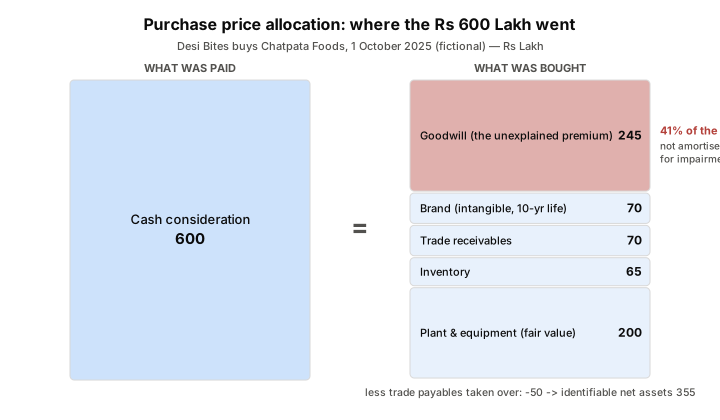
For Chatpata Foods:
| What Desi Bites got | ₹ lakh |
|---|---|
| Plant and equipment (at fair value) | 200 |
| Inventory | 65 |
| Trade receivables | 70 |
| The brand (an identifiable intangible, 10-year life) | 70 |
| Less: trade payables taken over | −50 |
| Identifiable net assets | 355 |
| Goodwill (₹600 − ₹355) | 245 |
40.8% of the price is goodwill. That’s the premium Desi Bites paid over what it could point to: distributor relationships, a regional customer habit, the expected savings from running two brands through one sales force. Goodwill is real in the sense that the money was really spent. It is not an asset in the sense that anything in the balance sheet post was — you can’t sell it, depreciate it, or borrow against it.
Two consequences follow.
Goodwill isn’t amortised; it’s tested. The brand intangible is written off over ten years — ₹7 lakh a year, so ₹3.5 lakh for the six months of H2 FY26. Goodwill just sits there, at ₹245 lakh, until management concludes the acquired business is worth less than they paid — at which point it’s impaired, in one lump, through the P&L. Impairments arrive years after the deal, usually in a bad year when they can be buried, and they are the accounts finally admitting the price was wrong.
Goodwill inflates equity and total assets. Desi Bites’ FY26 equity includes ₹245 lakh of goodwill — 9.9% of it. Every ratio with equity or assets in the denominator (ROE, ROA, P/B) is now a little softer than it looks. Serial acquirers can have balance sheets that are half goodwill; strip it out (“tangible book value”) before comparing them with anyone else.
🧒 Explain it like I'm 10 (optional — skip if this is already clear)
Imagine buying a friend’s lemonade stand for ₹600. The table, the jug and the leftover lemons are worth ₹355. Why pay ₹600?
Because everyone on the street already knows to buy lemonade from that corner. That habit — the customers who’ll keep coming — is worth something, but you can’t put it in a box. Accountants call the extra ₹245 “goodwill” and write it down as a thing you own.
If the customers stop coming, the ₹245 was wasted, and one day you have to admit it. That admission is called an impairment.
Was it a good deal? The first-year arithmetic
The next post, on capital allocation, does this properly. The short version, on the numbers so far:
| Chatpata Foods, H2 FY26 (six months) | ₹ lakh |
|---|---|
| Revenue | 240 |
| EBITDA | 24 (10% margin, vs Desi Bites’ 17.1%) |
| EBIT after depreciation and brand amortisation | 8.5 |
| Price ÷ annualised revenue | 1.25x |
| Year-one return on the ₹600 lakh | 2.1% |
A 2.1% return on money that the WACC post said costs about 14% is, in year one, value-destroying. Management’s case is that margins will converge to Desi Bites’ own once the brand runs through its distribution. That’s the standard acquisition story and it’s sometimes true. The reader’s job is to hold management to it: the deal is judged on Chatpata’s margin in FY27 and FY28, not on the press release.
Note also the blended effect. Desi Bites’ own EBITDA margin was 17.1%; reported FY26 margin is 16.6%. The acquisition diluted the group margin while adding to revenue growth (27.3% reported versus 18.0% organic). A reader who saw “revenue up 27%, margin down” without knowing about the deal would draw exactly the wrong conclusion about the core business. Acquisitions change the base; always separate organic from acquired.
Exceptional items: the one-off that shouldn’t recur
The deal cost ₹35 lakh in stamp duty, advisers and rebranding. That’s a real cost of FY26 and a cost that has nothing to do with making namkeen, so it’s shown on its own line as an exceptional item rather than inside operating expenses:
| FY26 P&L below EBIT | ₹ lakh |
|---|---|
| EBIT (operating) | 393.5 |
| Other income | +85 |
| Exceptional items | −35 |
| Interest | −42 |
| PBT (profit before tax) | 401.5 |
Separating it is the honest presentation — it lets you see the operating business without the deal costs. The abuse is in the labelling. Watch for companies whose “exceptional” items are exceptional every single year: restructuring charges four years running, “one-time” inventory write-downs each Q4, impairments of last decade’s acquisitions. If it recurs, it’s operating, whatever the line says. A useful discipline is to sum five years of “exceptional” charges and compare the total with five-year PAT; if it’s a large share of profit, the business is worse than its headline numbers.
The opposite abuse also exists: a genuine one-off gain (selling a building, an insurance receipt) reported inside operating revenue or other income, where it lifts the margin quietly. The forensic post had one of those.
Other income: when the interest is bigger than the business deserves
Other income is everything the company earned that isn’t its business: interest on deposits, dividends on investments, gains on selling assets, rent, foreign exchange gains. Desi Bites’ was zero until the IPO and ₹85 lakh in FY26, almost all interest on the ₹1,600 lakh raised and not yet spent.
| FY26 | ₹ lakh |
|---|---|
| Other income | 85 |
| As a share of PBT | 21.2% |
| PAT as reported | 301.5 |
| PAT excluding other income and the exceptional item (after tax) | 264 |
A fifth of Desi Bites’ pre-tax profit came from a fixed deposit. That’s not wrong — the money is real — but it’s not the snacks business, and it won’t last: the cash is meant to be spent on the things the prospectus promised. A P/E computed on ₹301.5 lakh values the FD interest at the same multiple as the brand, which is absurd. Analysts strip it out: value the operating business on operating profit, and add the cash at face value.
The reading rule: other income above about 10% of PBT deserves a sentence in your notes, and above 20% it deserves a paragraph. Find out what it is (the note will list it). Interest on a genuine cash pile is benign. A gain on asset sales is a one-off wearing a recurring label. A large “miscellaneous income” line with no explanation is a question for the next investor call.
Common mistakes
- Reading goodwill as an asset like any other. It’s the unexplained part of a price. It produces nothing, can’t be sold, and is written off only when management admits the deal underperformed.
- Comparing P/B or ROE across companies without stripping goodwill. An acquisitive company’s equity is padded with premiums it paid; tangible book value is the like-for-like figure.
- Taking “exceptional” at face value. Count how many years in the last five had one. Recurring exceptionals are operating costs.
- Valuing other income at the business’s multiple. The cash is worth face value; its interest shouldn’t be capitalised at a P/E multiple, such as the 26.5 times FY26 earnings implied by the ₹640 IPO price (38.3 times on the FY25 earnings the IPO was priced off).
- Missing the base change. Reported growth after an acquisition is partly bought. Organic and acquired growth are different facts.
- Judging the deal on the announcement. Year-one returns on acquisitions are almost always poor. The verdict is the acquired business’s margin two and three years later — and whether goodwill is still on the books at full value.
Sources
- Indian Accounting Standards (Ind AS), Ministry of Corporate Affairs: the text of Ind AS 103, on business combinations and goodwill. Also: ICAI’s compendium of Ind AS.
Takeaway: An acquisition brings three lines a ratio reader can misread: goodwill, exceptional items and other income. Goodwill pads equity until it’s impaired, a recurring “exceptional” is an operating cost, and interest on idle cash deserves a fixed deposit’s valuation, not a brand’s. Separate organic from acquired, operating from other, and judge the deal in year three, not year one.
This post is for educational purposes only and is not investment advice. Wealth Primer explains concepts, not recommendations — nothing here is a suggestion to buy, sell, or hold any specific security or fund. The author is not a SEBI-registered Research Analyst or Investment Adviser. Any prices or figures used as worked examples are historical and shown only to illustrate a calculation. Past performance does not indicate future results. Please do your own research or consult a registered adviser before making investment decisions. See the privacy & disclaimer policy for more.