
Fundamental Analysis — Beginner to Expert · Part 20 of 37
Capital adequacy: the buffer that makes deposits safe
The question debt-to-equity was trying to ask
For a manufacturer, debt-to-equity and interest coverage answer one question: if things go wrong, how much can the company lose before the lenders lose too?
For a bank the question is identical and far more serious, because the “lenders” are depositors — millions of them, holding money they believe is safe. The bank ratios post showed that HDFC Bank’s equity is about 12.73% of its balance sheet. If loans worth more than that went bad and stayed bad, depositors would be the ones absorbing the loss.
Capital adequacy is the regulatory answer. It says: a bank must hold enough of its own money — shareholders’ capital, which can absorb losses without anyone being owed anything — relative to the risk it is running. Not relative to its size. Relative to its risk.
The formula, and why the denominator is odd
Capital adequacy ratio (CAR) = Regulatory capital / Risk-weighted assets (RWA)
Risk-weighted assets are the balance sheet re-counted by riskiness. Each asset is multiplied by a weight that reflects how likely it is to lose money:
| Asset | Typical risk weight (simplified) |
|---|---|
| Cash, balances with RBI, government securities | 0% |
| Home loans (well-collateralised) | 35–50% |
| Corporate loans (depends on rating) | 20–150% |
| Unsecured personal loans | 125% |
| Credit-card receivables | 150% |
| Certain exposures RBI wants to discourage | higher, by regulation |
So ₹100 of government bonds adds ₹0 to RWA; ₹100 of credit-card balances adds ₹150. (Those two unsecured rows were raised by RBI, November 2023: personal loans from 100% to 125%, and bank credit-card receivables from 125% to 150%.) A bank with a large, safe book has RWA well below its total assets; a bank lending aggressively can have RWA near or above them. (Those weights cover credit risk; total RWA also adds charges for market risk and operational risk.)
Regulatory capital comes in layers, in order of how cleanly each can absorb a loss:
| Layer | What it is | Absorbs losses… |
|---|---|---|
| Common Equity Tier 1 (CET1) | Share capital plus retained earnings and reserves, less deductions | First, while the bank is still operating |
| Additional Tier 1 (AT1) | Perpetual bonds that convert to equity or are written down if capital falls too far | Next, by contract |
| Tier 2 | Subordinated debt with a long maturity, certain provisions | Only if the bank fails |
Tier 1 is CET1 plus AT1. Total capital adds Tier 2. Each has its own minimum, and CET1’s is the one that matters most because it is the only layer that is unambiguously the shareholders’ money.
Worked example: HDFC Bank, 31 March 2025
From HDFC Bank’s results for the year ended 31 March 2025 (standalone). Historical, for illustration only.
| Item | Reported |
|---|---|
| Risk-weighted assets | ≈ ₹26,60,000 crore |
| Total assets, for comparison | ₹39,10,198.94 crore |
| RWA as % of total assets | 68.0% |
| CET1 ratio | 17.2% |
| Tier 1 ratio | 17.7% |
| Total CAR | 19.55% (FY24: 18.8%) |
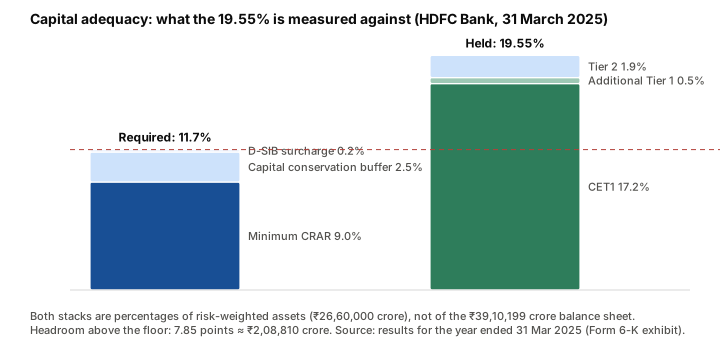
The filing’s own sentence: the CAR “was at 19.6% as on March 31, 2025 … as against a regulatory requirement of 11.7%.”
Two things to read off this. First, RWA is about 68% of the balance sheet — roughly ₹26.6 lakh crore of “risk” on ₹39.1 lakh crore of assets, because a large slice of the assets is government securities and cash that carry no weight. Second, almost all of the capital is the good kind: CET1 is 17.2 of the 19.55 points.
What the 11.7% is made of
The regulatory floor isn’t one number; it is a stack, and the filing’s 11.7% is the sum for this particular bank:
| Component | % of RWA | What it is |
|---|---|---|
| Minimum total capital (CRAR) | 9.0% | RBI’s base requirement — one point above the international Basel III minimum of 8% |
| Capital conservation buffer | 2.5% | Must be met from CET1; a bank that dips into it faces restrictions on dividends and bonuses |
| D-SIB surcharge | 0.2% | Extra CET1 for banks RBI designates as domestic systemically important — too big to be allowed to fail quietly |
| Requirement | 11.7% |
Within the base 9%, RBI requires at least 5.5% as CET1 and 7% as Tier 1. The D-SIB surcharge depends on the bucket RBI places a bank in, and it moves. The 0.2% above is what applied to HDFC Bank on 31 March 2025. RBI’s list of 2 December 2025 puts HDFC Bank in bucket 2, an additional CET1 requirement of 0.4% of risk-weighted assets on top of the capital conservation buffer — which would lift the floor to 11.9%. The release doesn’t state the date from which a bucket change applies, so check that date in RBI’s list for the year in question, and always check the current designation rather than the last one you read.
The headroom, in rupees
Ratios in percentage points hide the scale. Convert:
| Item | ₹ crore |
|---|---|
| Capital held (≈ 19.55% of RWA) | 5,20,030 |
| Capital required (≈ 11.7% of RWA) | 3,11,220 |
| Headroom above the floor (7.85 points) | 2,08,810 |
About ₹2.09 lakh crore of capital sits above the regulatory minimum. For a sense of proportion: the entire gross NPA book from the previous post was ₹35,222.64 crore — about 7.7% of the bank’s CET1 capital. That is the comparison capital adequacy is built to make: the losses that have shown up so far, against the money available to absorb losses.
This is a statement about the arithmetic at one date, not about safety in general. Capital ratios are computed on the current risk weights and the current classification of loans; a severe enough shock changes both at once.
🧒 Explain it like I'm 10 (optional — skip if this is already clear)
Imagine you run a lending club with your classmates’ money. The teacher sets a rule: for every ₹100 you lend to a risky borrower, you must have ₹12 of your own pocket money in the club. For lending to the safest kids, you need almost none.
Why? Because if the risky borrowers don’t pay, the loss comes out of your pocket money first — and your classmates still get all their money back. Your pocket money is the capital. The teacher’s ₹12-per-₹100 rule is capital adequacy. And the risky-vs-safe weighting is risk-weighted assets.
If you have ₹19.55 for every ₹100 instead of ₹12, you’ve got a cushion. If you’re at ₹11, the teacher stops you lending more until you top it up.
Why capital is expensive, and why that matters
Every rupee of equity a bank holds is a rupee it isn’t leveraging. The bank ratios post showed ₹1 of equity supporting about ₹7.9 of assets. More capital means a lower multiple, which — for the same return on assets — means a lower return on equity. That trade-off is the whole tension of bank regulation: regulators want more capital; shareholders’ returns are diluted by it.
It is also why a bank raises capital: when RWA grows (more lending, or a shift into higher-weight loans) faster than retained profits add to CET1, the ratio falls toward the floor and the bank must either slow lending or issue shares. Watching the CET1 ratio trend tells you how much room a bank has to grow before that choice arrives.
Common mistakes
- Dividing capital by total assets. That is a leverage ratio, which RBI also tracks, but it isn’t CAR. CAR’s denominator is risk-weighted, which is why RWA is about 68% of assets here.
- Reading a high CAR as a target. Capital above the floor is a buffer, and it’s also an unleveraged asset. Banks manage toward a comfortable level, not toward the maximum.
- Ignoring the layers. Two banks at 16% CAR, one with 15% CET1 and one with 10% CET1 plus a lot of Tier 2 debt, are not equally capitalised. CET1 is the number to anchor on.
- Treating risk weights as fixed truth. They are regulatory conventions and RBI changes them — raising weights on unsecured consumer credit, for example, mechanically lowers every affected bank’s CAR overnight with no change in the loans themselves.
- Assuming the minimum is the same for every bank. D-SIB surcharges differ by bank and are reviewed. Read the requirement the bank itself states in its filing.
Takeaway: Capital adequacy asks how much of a bank’s own money stands between its risks and its depositors, measured against risk-weighted assets, not the balance sheet. HDFC Bank’s FY25 filing shows 19.55% against an 11.7% floor, most of it in CET1. It is the ratio that replaces debt-to-equity for a bank, and the one that decides how fast it can grow.
This post is for educational purposes only and is not investment advice. Wealth Primer explains concepts, not recommendations — nothing here is a suggestion to buy, sell, or hold any specific security or fund. The author is not a SEBI-registered Research Analyst or Investment Adviser. Any prices or figures used as worked examples are historical and shown only to illustrate a calculation. Past performance does not indicate future results. Please do your own research or consult a registered adviser before making investment decisions. See the privacy & disclaimer policy for more.