
Mutual Funds, Minus the Marketing · Part 4 of 23
Expense ratio in mutual funds: direct vs regular plan
A fee you never see
The expense ratio is what a fund charges annually to run itself — management fees, administration, distributor commissions, marketing. It’s quoted as a percentage of assets: a 1.5% expense ratio on ₹1,00,000 costs ₹1,500 a year.
You will never see this charged. No debit appears, no statement line itemises it — as the opening post noted, every NAV you have ever seen is already net of it. It’s deducted from the fund’s assets daily, before NAV is published. Every return you have ever seen quoted for a fund is already net of it.
That invisibility is exactly why it deserves a post. A cost you never consciously pay is a cost you never think about.
The natural experiment
Ordinarily, working out what fees cost you means comparing different funds — and then you can’t separate the fee from everything else that differs.
Indian mutual funds hand us a perfect controlled experiment. Since January 2013, every scheme has been available in two plans:
| Plan | What it is |
|---|---|
| Regular | Bought through a distributor, whose trail commission is built into the expense ratio |
| Direct | Bought straight from the AMC (asset management company, the firm that runs the fund) — same fund, no commission |
Same portfolio. Same fund manager. Same securities, bought and sold on the same days, in the same proportions. The only difference is the commission inside the expense ratio.
So any divergence between the two NAVs over time is the fee. Nothing else.
🧒 Explain it like I'm 10 (optional — skip if this is already clear)
Imagine two identical piggy banks, filled the same way, on the same days, for thirteen years.
The only difference: one has a tiny hole in the bottom. Every day, a few paise fall out.
You’d never notice a few paise. But leave it thirteen years and open both, and one has noticeably less in it. Nothing was stolen dramatically — it leaked, so slowly you couldn’t see it happening.
The expense ratio is the hole. This post is about measuring it by weighing both piggy banks.
The formula
Value after N years ≈ Initial × (1 + r − fee)^N

where r   = the portfolio's gross return
      fee = the expense ratio
The fee subtracts from the return every year, and the loss compounds — you lose the fee, and also all the growth that fee would have produced.
Two real comparisons
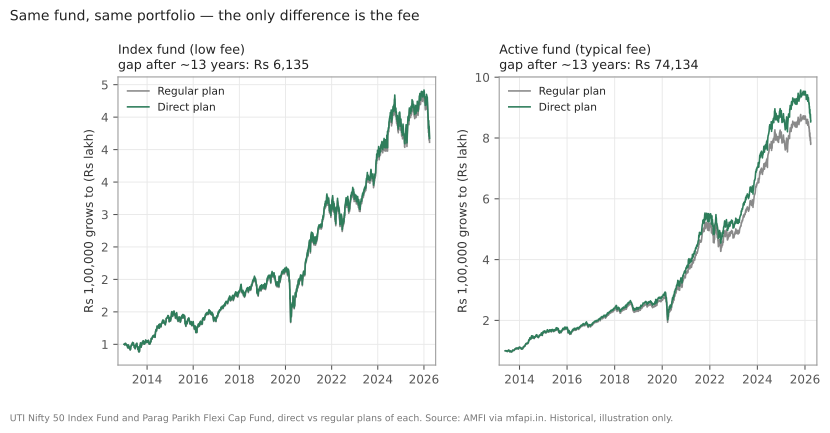
Source: AMFI via mfapi.in. Historical data, for illustration only.
The index fund, from 2 January 2013 to 31 March 2026 (13.2 years):
| Regular | Direct | |
|---|---|---|
| CAGR | 11.271% | 11.395% |
| ₹1,00,000 grew to | ₹4,11,243 | ₹4,17,378 |
A gap of 0.125 percentage points a year, worth ₹6,135 — about 1.5% more money for doing nothing except buying the same fund a different way.
That’s a modest number, and it’s modest for a good reason: index funds are already cheap, so there isn’t much commission to remove. Which makes the second comparison the instructive one.
An actively managed fund, Parag Parikh Flexi Cap Fund (AMFI scheme codes 122640 regular, 122639 direct), with a more typical expense ratio, from 28 May 2013 to 31 March 2026 (12.8 years):
| Regular | Direct | |
|---|---|---|
| CAGR | 17.38% | 18.21% |
| ₹1,00,000 grew to | ₹7,82,713 | ₹8,56,848 |
Here the gap is 0.83 percentage points a year — and on ₹1,00,000 over nearly thirteen years that comes to ₹74,134, or 9.5% more money.
To be explicit about what this comparison is and isn’t: the fund on both sides of that table is the same fund. This post takes no view on whether it is a good fund, and nothing here should be read as suggesting anyone buy or avoid it. It appears because it has a normal actively-managed expense ratio and nearly thirteen years of both plans, which is what the arithmetic needed.
Why 0.83% becomes 9.5%
The leap from “under one percent a year” to “₹74,000” is the part worth sitting with, and it’s just compounding running against you.
Each year you keep 0.83% less. The following year, that missing amount isn’t there to grow either. Over nearly thirteen years the shortfall compounds into roughly a tenth of the final corpus — and over a thirty-year investing life it would be far larger still.
A useful rough guide: over long periods, each 1% of annual fee costs roughly 20–25% of your final corpus over 30 years. Not 1%. That’s the number worth carrying around.
What you actually get for it
None of this makes fees illegitimate. Running a fund costs money, and active management costs more than tracking an index. SEBI caps total expense ratios on a sliding scale by fund size and type — since 1 April 2026 under the SEBI (Mutual Funds) Regulations, 2026 — and the caps are meaningful.
The honest questions are narrower:
- For the regular-plan premium specifically: are you receiving advice worth 0.83% a year? If a distributor is genuinely planning, rebalancing and stopping you from panic-selling in a crash, that can be worth well more than the fee. If they sold you a fund once and haven’t called since, it isn’t.
- For active management generally: is the manager beating a comparable index by more than the extra fee, consistently? That’s the subject of the benchmarks post later in this series.
Fees are only “high” or “low” relative to what they buy.
Doing it in Python
import pandas as pd

nav = pd.read_csv("uti-nifty50-index-fund-nav.csv",
                  parse_dates=["date"]).set_index("date")
start, end = pd.Timestamp("2013-01-02"), pd.Timestamp("2026-03-31")
years = (end - start).days / 365.25

for plan in ["nav_regular_growth", "nav_direct_growth"]:
    s = nav[plan].dropna()
    cagr = ((s.asof(end) / s.asof(start)) ** (1/years) - 1) * 100
    print(f"{plan:20s} CAGR {cagr:.3f}%  "
          f"Rs 1,00,000 -> Rs {100000 * s.asof(end)/s.asof(start):,.0f}")
Common mistakes
- Thinking the expense ratio is charged separately. It’s already inside every NAV, which is what makes it so easy to ignore.
- Dismissing a 1% fee as small. Over thirty years it’s a fifth to a quarter of the final corpus.
- Holding regular plans by inertia. Many people bought regular plans before direct existed, or without knowing the choice existed. Switching has tax consequences worth checking, but the ongoing cost is worth knowing.
- Assuming direct is automatically right. Direct means no bundled advice — if you want advice you pay for it separately (e.g. a fee-only SEBI-registered investment adviser). If advice is what stops you selling at the bottom of a 60% drawdown, it may be the best money you spend — just pay for it knowingly.
- Comparing expense ratios across categories. Index funds, active equity and debt funds have structurally different cost bases and different caps.
- Ignoring exit loads and taxes when switching. Moving from regular to direct is a redemption and a fresh purchase, with the tax that implies.
Takeaway: The expense ratio is deducted from NAV daily, so you never see it — but comparing a fund’s direct and regular plans isolates it exactly, since everything else about them is identical. On an actively managed fund that gap was 0.83% a year, which over nearly thirteen years came to 9.5% of the final corpus. Small annual percentages are not small.
This post is for educational purposes only and is not investment advice. Wealth Primer explains concepts, not recommendations — nothing here is a suggestion to buy, sell, or hold any specific security or fund. The author is not a SEBI-registered Research Analyst or Investment Adviser. Any prices or figures used as worked examples are historical and shown only to illustrate a calculation. Past performance does not indicate future results. Please do your own research or consult a registered adviser before making investment decisions. See the privacy & disclaimer policy for more.