
Risk, Leverage and Your Own Brain · Part 9 of 16
Risk of ruin and the Kelly criterion: the maths of how much to bet
Two ways to lose everything with an edge
Suppose you really do have an edge: a bet that wins a little more often than it loses. There are still two ways to go broke with it. Bet a fixed amount too large for your capital and a normal losing streak wipes you out before the edge has time to show up. Bet too large a fraction of your capital each time and something subtler happens: your money shrinks over time even though every single bet is in your favour.
Risk of ruin is the chance that a betting or trading plan loses all of its capital — or, more usefully, falls to a level you can’t come back from. The Kelly criterion is the answer to the question underneath it: if you have an edge, what fraction of your current capital should each bet be, so that your money grows as fast as possible over the long run? John L. Kelly Jr. derived it at Bell Labs in 1956 (A New Interpretation of Information Rate, Bell System Technical Journal), and the mathematician Edward Thorp took it from blackjack tables to markets. His survey chapter, The Kelly Criterion in Blackjack, Sports Betting, and the Stock Market (2006), is the source for the drawdown results below.
This post is maths on a coin and on historical fund returns. The fractions that come out are properties of the examples, not a sizing recommendation — and the second half of the post is about why the formula’s input is the part you should trust least. It picks up where the position sizing post left off: that post fixed the rupees at risk per trade by convention; Kelly tries to derive the stake from the edge.
The formula
A bet that wins with probability p and loses with probability q = 1 − p.
A win pays b times the stake; a loss costs the stake.

Growth per bet if you stake a fraction f of capital:
    g(f)  =  p × ln(1 + b·f)  +  q × ln(1 − f)

Kelly fraction (the f that maximises g):
    f*  =  (b·p − q) / b          even-money bet (b = 1):  f* = p − q

Continuous version, for an asset with expected excess return μ − r
and volatility σ (both annual):
    f*  =  (μ − r) / σ²

Gambler's ruin — a FIXED stake, N stakes of capital, even money, p > ½:
    P(eventually lose everything)  =  (q / p)^N

Thorp, for betting a fraction c of Kelly (c = 1 is full Kelly):
    P(capital ever falls to a fraction x of the start)  =  x^(2/c − 1)
Three things to notice. Kelly maximises the growth rate — the average of the logarithm of wealth — not the average outcome. It stakes a fraction, so the rupee bet shrinks after losses and grows after wins, which is why a pure fraction never literally hits zero. And the whole thing runs on p and b (or μ, r and σ): numbers you have to estimate.
🧒 Explain it like I'm 10 (optional — skip if this is already clear)
You have a coin that lands heads a bit more than half the time, and every heads wins you as much as you bet. Should you bet all your pocket money on each toss? No — one tails and you’re done forever. Should you bet one rupee at a time? You’d be safe, but you’d barely grow.
Kelly is the in-between answer: always bet the same slice of whatever you have right now. With this coin the best slice is small. Bet a bigger slice and the bad tosses hurt so much more than the good ones help that you end up poorer, even with a lucky coin.
Worked example: a coin that lands heads 55% of the time
An even-money bet (b = 1) that wins 55% of the time and loses 45%. Kelly says f* = 55% − 45% = 10% of current capital per bet. Here is the growth rate at different fractions, and what it compounds to over 1,000 bets for the typical (median) player:
| Fraction staked | × Kelly | Growth per bet | Median wealth after 1,000 bets |
|---|---|---|---|
| 2.5% | 0.25 | 0.219% | 8.9× |
| 5% | 0.5 | 0.375% | 42.6× |
| 7.5% | 0.75 | 0.469% | 109.3× |
| 10% | 1 | 0.501% | 149.7× |
| 15% | 1.5 | 0.374% | 41.9× |
| 20% | 2 | −0.014% | 0.9× |
| 25% | 2.5 | −0.673% | 0× |
The curve is lopsided. Half Kelly (5%) keeps 75% of the maximum growth rate. Double Kelly (20%) — the same edge, the same coin — has a growth rate of roughly zero: growth crosses zero at 19.9%, and anything beyond shrinks your money in the long run. That’s Thorp’s point about overbetting: being too aggressive is punished far more than being too timid.
Why full Kelly is brutal
Maximum growth doesn’t mean a comfortable ride. We simulated
20,000 players, each making
1,000 bets on the same coin (fixed random seed, in
scripts/derive_risk2.py):
| Strategy | Chance of falling to half the start, at some point | Chance of losing 70%, at some point | Chance of ending below the start | Median final wealth |
|---|---|---|---|---|
| Half Kelly (5%) | 11.3% | 2.4% | 0.8% | 42.6× |
| Full Kelly (10%) | 46.7% | 27.4% | 5.9% | 149.7× |
| Double Kelly (20%) | 90.6% | 84.4% | 51.6% | 0.9× |
Thorp’s formula gives the long-run chance of ever halving as 50% at full Kelly and 12.5% at half Kelly; the simulation, over a finite 1,000 bets, lands just under both. So a full-Kelly bettor with a genuine edge, known exactly, still has roughly even odds of watching their capital halve along the way. Thorp wrote that most cautious users “find the frequency of substantial bankroll reduction to be uncomfortably large”, and bet less. Recall from the arithmetic of losses what a 50% drawdown needs to repair: a 100% gain.
Fixed stakes: the gambler’s ruin
The other way to be ruined is to bet a fixed rupee amount. With N stakes of capital, the chance of eventually losing everything:
| Win probability | 5 stakes | 10 stakes | 20 stakes | 50 stakes |
|---|---|---|---|---|
| 50% | 100% | 100% | 100% | 100% |
| 51% | 81.9% | 67% | 44.9% | 13.5% |
| 53% | 54.8% | 30.1% | 9% | 0.2% |
| 55% | 36.7% | 13.4% | 1.8% | 0% |
At a fair 50/50, ruin is certain eventually, however deep your pockets. A genuine 55% edge with only five stakes of capital still carries a 36.7% chance of going broke. Edge and staying power are different things.
The weak link: the edge you plug in
Every number above assumed you know the win probability is 55%. You never do. Here’s what happens if you believe 55% and bet accordingly, but the true probability is lower:
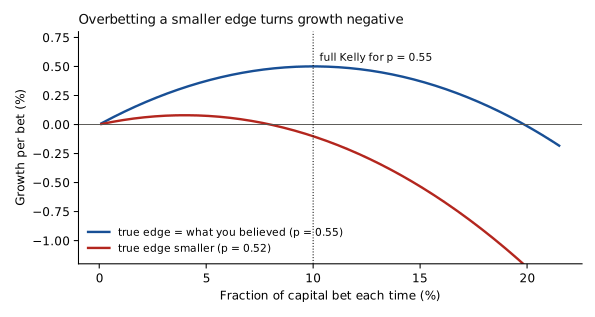
| True win probability | True Kelly fraction | Growth per bet, staking 10% (full Kelly on your belief) | Growth per bet, staking 5% (half) | Median wealth after 1,000 bets: 10% / 5% |
|---|---|---|---|---|
| 55% | 10% | 0.501% | 0.375% | 149.66× / 42.63× |
| 54% | 8% | 0.3% | 0.275% | 20.12× / 15.67× |
| 53% | 6% | 0.099% | 0.175% | 2.7× / 5.76× |
| 52% | 4% | −0.101% | 0.075% | 0.36× / 2.12× |
| 51% | 2% | −0.302% | −0.025% | 0.05× / 0.78× |
| 50% | 0% | −0.503% | −0.125% | 0.01× / 0.29× |
Overestimate a 52% edge as 55% and full Kelly shrinks the typical player’s money to 0.36× over 1,000 bets — while half Kelly, on the same wrong belief, still grows it to 2.12×. That’s the practical case for fractional Kelly: not timidity, but insurance against your own estimate.
What “the edge” looks like on real data
The continuous formula f* = (μ − r) / σ² can be fed actual history. We did it for the UTI Nifty 50 Index Fund (regular-plan growth NAV, or net asset value; AMFI, the Association of Mutual Funds in India, via mfapi.in), using financial-year returns over every rolling five-year window, with the UTI Overnight Fund’s return as r. Before 2018 that fund wasn’t an overnight portfolio, so read it as a cash-like proxy. Data to 31 March 2026; historical, for illustration only.
| Window | Mean return over cash | Volatility | “Kelly fraction” |
|---|---|---|---|
| FY07–FY11 | 10.5% | 38.5% | 0.71 |
| FY08–FY12 | 6% | 40.2% | 0.37 |
| FY09–FY13 | 2.8% | 39.8% | 0.17 |
| FY10–FY14 | 13.6% | 30.8% | 1.44 |
| FY11–FY15 | 3.3% | 13.7% | 1.78 |
| FY12–FY16 | −1% | 16.1% | −0.39 |
| FY13–FY17 | 4.6% | 13.7% | 2.47 |
| FY14–FY18 | 6% | 13.5% | 3.31 |
| FY15–FY19 | 6.1% | 13.3% | 3.42 |
| FY16–FY20 | −3.8% | 19% | −1.04 |
| FY17–FY21 | 13.1% | 34.9% | 1.08 |
| FY18–FY22 | 14.3% | 34.9% | 1.17 |
| FY19–FY23 | 12% | 35.8% | 0.94 |
| FY20–FY24 | 14.6% | 36.3% | 1.11 |
| FY21–FY25 | 20.6% | 28.4% | 2.55 |
| FY22–FY26 | 4.9% | 14.1% | 2.45 |
The same fund, the same formula, and the answer ranges from −1.04 (bet against it) to 3.42 (borrow to hold 3.42 times your capital), depending on which five years you happened to feed it. 2 of 16 windows said short it; 10 said use leverage. This is not a finding about the index fund. It’s the estimation problem made visible: five annual returns can’t pin down μ, and Kelly is very sensitive to μ. Anyone who quotes a single Kelly fraction for an asset is quoting a guess about the future dressed as a formula.
Doing it in Python
import numpy as np

p, f, bets, players = 0.55, 0.10, 1000, 20_000
rng = np.random.default_rng(0)
wins = rng.random((players, bets)) < p
log_path = np.cumsum(np.where(wins, np.log1p(f), np.log1p(-f)), axis=1)

ever_halved = (log_path.min(axis=1) <= np.log(0.5)).mean()
median_end = np.exp(np.median(log_path[:, -1]))
print(f"ever halved: {ever_halved:.1%}   median final wealth: {median_end:.1f}x")

# the growth rate for any fraction, true p and payoff b
g = lambda f, p, b=1: p * np.log1p(b * f) + (1 - p) * np.log1p(-f)
print([round(g(x, 0.52) * 100, 3) for x in (0.05, 0.10)])   # believed 0.55, truth 0.52
Change p to 0.52 while leaving f at 0.10 and watch the median fall below
one: the believed edge was 0.55, the true one smaller.
Common mistakes
- Treating the Kelly fraction as a target. It’s a ceiling. Because overbetting is punished so much harder than underbetting, most people who use Kelly at all use a fraction of it — and still size positions with the cruder rules from the position sizing post.
- Plugging in a backtested edge. A win rate from your own backtest is the most optimistic estimate you’ll ever have — see backtesting honestly. If the true edge is even a few points smaller, full Kelly on the backtest can shrink your money.
- Assuming markets are coins. The coin has fixed odds, independent tosses and a known payoff. Markets have fat tails, gaps through stops, changing odds and bets that move together. Ten “independent” positions in correlated stocks are closer to one big bet, as the diversification post showed — and Kelly sized as if they were ten is overbetting.
- Reading “never goes broke” as “safe”. A fraction bet never reaches exactly zero, but a 90% drawdown is ruin in every sense that matters — for your plans and for your nerve.
Takeaway: Kelly tells you the stake that grows capital fastest if you know your edge exactly — and even then it means a coin-flip chance of halving along the way. You never know your edge exactly, and betting double the true Kelly fraction grows nothing. The formula’s real lesson is directional: when unsure, bet smaller.
This post is for educational purposes only and is not investment advice. Wealth Primer explains concepts, not recommendations — nothing here is a suggestion to buy, sell, or hold any specific security or fund. The author is not a SEBI-registered Research Analyst or Investment Adviser. Any prices or figures used as worked examples are historical and shown only to illustrate a calculation. Past performance does not indicate future results. Please do your own research or consult a registered adviser before making investment decisions. See the privacy & disclaimer policy for more.