
Mutual Funds, Minus the Marketing · Part 15 of 30
STP and SWP: pacing money in, and pacing it out
Two plumbing tools
The SIP post covered money arriving monthly from a salary. Two other situations come up constantly and have their own plumbing:
- You have a lump sum now — a bonus, a maturity, a property sale — and the idea of putting all of it into equity on one day makes you nervous. An STP — systematic transfer plan — parks the money in a low-volatility fund (usually a liquid or overnight fund) and moves a fixed amount into an equity fund every month, automatically.
- You have a corpus and need income from it — retirement, a sabbatical, school fees. An SWP — systematic withdrawal plan — redeems a fixed rupee amount from a fund every month and pays it to your bank account.
Both are just standing instructions to the fund house. Neither is a strategy in itself. What they do to your money depends entirely on what the market does during the months they’re running — which is the part worth seeing on real numbers.
STP: the same ₹12 lakh, three ways in
Take ₹12,00,000, and three ways to invest it in the Nifty 50 index fund this series has used throughout:
- Lump sum: all of it into the index fund on day one.
- STP: park it in a low-volatility debt fund; move ₹1,00,000 into the index fund on the first of each month for 12 months. The unmoved balance keeps earning the parking fund’s returns.
- Do nothing: leave it in the parking fund.
Regular plans; source AMFI NAV history via mfapi.in (api.mfapi.in/mf/ followed by the scheme code). Historical data, for illustration only — the funds are the same ones used all series, chosen for their history, not their merits.
One caveat about that parking fund. It’s UTI’s scheme that became its overnight fund on 3 May 2018, under SEBI’s recategorisation. Before that date it ran a different portfolio that wasn’t an overnight fund, which is why the debt funds post doesn’t use that older history. So wherever the numbers below start before May 2018 (the 2008 and 2015 STP rows, and the 2008 and 2010 SWP rows), read the parking fund as “a low-volatility debt fund of its day”, not as what a modern overnight fund would have done.
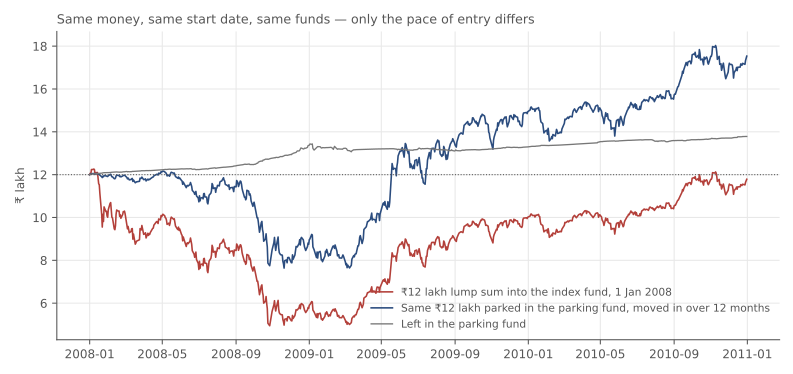
| Start | Lump sum after 3 years | STP after 3 years | Parking fund only, after 3 years |
|---|---|---|---|
| Jan 2008 (top of the market) | ₹11,78,559 | ₹17,53,441 | ₹13,78,336 |
| Jan 2015 | ₹15,50,065 | ₹15,91,680 | ₹14,84,498 |
| Apr 2020 (COVID low) | ₹25,84,766 | ₹19,04,394 | ₹13,44,479 |
Three rows, two different winners — and the “safe” option of leaving it all in the parking fund won none of them. The pattern is not subtle.
Starting at the January 2008 top, the lump sum was still below ₹12 lakh three years later. The STP, which bought most of its units during the 2008 collapse at far lower NAVs, was worth ₹17,53,441 — about ₹5.75 lakh more. By March 2026 the gap had compounded: the lump sum was worth ₹47,43,980, the STP ₹70,03,944.
Starting at the April 2020 low, the opposite. The market rose almost every month the STP was running, so each transfer bought at a higher NAV than the last. The lump sum finished three years at ₹25,84,766; the STP at ₹19,04,394 — some ₹6.8 lakh behind.
Starting in January 2015, an ordinary year, the two were within a few percent of each other.
So: an STP is insurance against investing everything just before a fall. Like all insurance it has a premium, and the premium is the return you give up when the market rises while you’re still half in cash. Most twelve-month windows go up — 81% of all one-year windows in this index fund’s history ended higher, which is the whole reason to own equity — so the premium is paid more often than the insurance pays out. When it does pay out, as in 2008, it pays out a great deal.
🧒 Explain it like I'm 10 (optional — skip if this is already clear)
You’ve got ₹120 to spend on a toy that changes price every month. You can buy it all today, or buy a bit each month for a year.
If the price is about to drop, spreading it out is brilliant — you get more toy for the same money. If the price is about to climb, spreading it out means you keep paying more each month and wish you’d bought it all at the start.
You don’t know which will happen. Spreading it out is choosing to be a bit wrong either way rather than very wrong one way.
SWP: the same ₹1 crore, drawn down from three dates
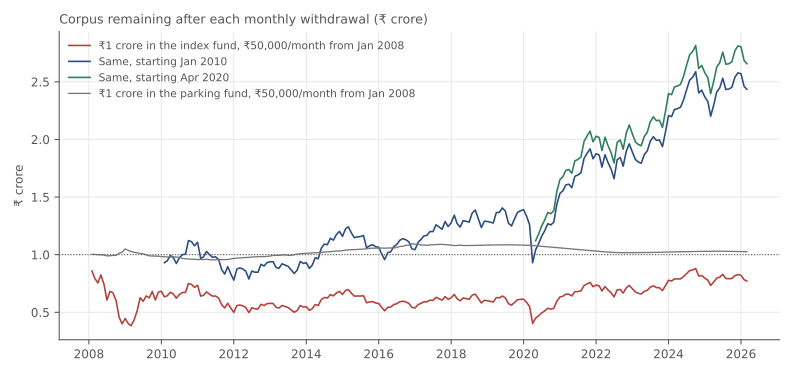
Now the other direction. ₹1,00,00,000 in the index fund, withdrawing ₹50,000 on the first of every month — ₹6 lakh a year, a 6% initial withdrawal rate — starting on three different dates, and running to 31 March 2026.
| Start | Withdrawals made | Total withdrawn | Corpus left, index fund | Corpus left if it had sat in the parking fund |
|---|---|---|---|---|
| Jan 2008 (top of the market) | 218 | ₹1,09,00,000 | ₹69,24,162 | ₹1,03,00,256 |
| Jan 2010 | 194 | ₹97,00,000 | ₹2,18,62,550 | ₹1,07,37,591 |
| Apr 2020 (COVID low) | 71 | ₹35,50,000 | ₹2,38,55,729 | ₹92,27,713 |
Start in January 2010 and the story is the one SWP marketing tells: you withdraw ₹97 lakh over sixteen years and the corpus more than doubles anyway.
Start two years earlier, in January 2008, with the identical fund and the identical withdrawal, and the corpus falls to ₹38,36,678 by 1 March 2009 — you’ve taken out ₹7 lakh and lost another ₹55 lakh to the crash. It never gets back above the original ₹1 crore. Eighteen years on it stands at ₹69,24,162, having paid out ₹109 lakh — not a disaster, but a completely different retirement from the 2010 one, and the difference is which two years you were unlucky enough to start in.
That is sequence-of-returns risk: when you are withdrawing, the order of returns matters, not just their average. A crash in year one of an SWP forces you to sell units cheaply to fund the withdrawal, and those units are gone when the recovery comes. The same crash in year fifteen barely matters. The risk series’ post (linked above) covers it in full; the table above is the short version.
One more column to notice: from the 2008 start, the parking fund ended with more corpus than the equity fund. (Before May 2018 it wasn’t yet an overnight fund and did have down days — plenty of them — but its swings were tiny next to equity’s.) Across the other two starts, equity won by a wide margin. Low volatility during withdrawals is worth more than it looks.
Tax, briefly
Both tools create taxable events every month:
- An STP is a redemption from the parking fund each month (debt-fund gains, generally taxed at slab rate; check which rule applies to your fund) and a purchase into the equity fund — so it creates a fresh tax lot with its own holding period every month.
- An SWP is a monthly redemption; each one is generally matched to your oldest units first under FIFO — first in, first out (the FIFO post in the Tax series walks through it). So in a fund you’ve held for years, or built up through a SIP, the oldest (and usually cheapest) units go first, so the withdrawals are gain-heavy from the very first month. The opposite pattern — mostly your own capital back early on, more gain later — only applies to a lump sum invested just before the SWP starts, because those units haven’t had time to grow.
The tax series has the rates; the mechanics are the same as any redemption, just twelve times a year.
Tax isn’t the only deduction. An SWP from an equity fund that starts within the fund’s exit load window — commonly 1% on units held less than a year — pays that load on every early withdrawal. An STP out of a liquid fund pays an exit load on units redeemed within 7 calendar days of investment: SEBI requires one, on a graded minimum scale that AMFI sets (Master Circular for Mutual Funds, 20 March 2026, para 5.6.5). Check the scheme’s exit-load terms before you set either one up.
Doing it in Python
An SWP is a loop that sells units at each month’s NAV:
import pandas as pd

nav = pd.read_csv("uti-nifty50-index-fund-nav.csv",
                  parse_dates=["date"]).set_index("date").nav_regular_growth

def swp(start, corpus=1e7, monthly=5e4, end="2026-03-31"):
    units = corpus / nav.loc[start:].iloc[0]
    for dt in pd.date_range(start, end, freq="MS")[1:]:
        px = nav.loc[dt:].iloc[0]
        if units * px < monthly:
            return f"ran out on {dt.date()}"
        units -= monthly / px
    return round(units * nav.loc[:end].iloc[-1])

for s in ["2008-01-01", "2010-01-01", "2020-04-01"]:
    print(s, swp(s))
Swap the withdrawal for a transfer between two NAV series and the same loop is an STP.
Common mistakes
- Treating an STP as a return-enhancer. It lowers the variance of your entry price. On average, over most windows, it costs return. That is a reasonable trade for someone who would otherwise not invest at all — it is not free money.
- Running an STP for years. Twelve months of transfers reduces bad-timing risk meaningfully; a five-year STP mostly means holding cash for five years.
- Setting an SWP rate off a good decade. 6% looked comfortable from 2010. From 2008 it cut the corpus by more than half within 14 months, and the corpus never recovered to ₹1 crore. Withdrawal rates need to survive the bad start, not the average one.
- Drawing an SWP from a 100% equity fund. The 2008 row is what that looks like. A withdrawal portfolio usually wants a low-volatility bucket to draw from while equity recovers.
- Forgetting both create monthly tax lots. Twelve redemptions a year is twelve entries in your capital gains statement.
- Starting an SWP inside the exit-load window. Withdrawals from units bought less than a year ago can each lose the exit load (often 1%), on top of tax.
Sources
- SEBI Master Circular for Mutual Funds (20 March 2026): SEBI’s master circular, including its text on exit loads.
- AMFI, net asset value data: the NAV data behind the worked examples.
Takeaway: An STP paces a lump sum into equity and an SWP paces a corpus out; neither changes what the market does, only how many months of it you’re exposed to. On real data, a 12-month STP from the January 2008 top beat the lump sum by ₹5.7 lakh in three years and lost to it by ₹6.8 lakh from the 2020 low, while an SWP begun in 2010 doubled its corpus and the identical plan begun in 2008 never recovered its starting value. The tool is neutral; the start date isn’t.
This post is for educational purposes only and is not investment advice. Wealth Primer explains concepts, not recommendations — nothing here is a suggestion to buy, sell, or hold any specific security or fund. The author is not a SEBI-registered Research Analyst or Investment Adviser. Any prices or figures used as worked examples are historical and shown only to illustrate a calculation. Past performance does not indicate future results. Please do your own research or consult a registered adviser before making investment decisions. See the privacy & disclaimer policy for more.
Tax rules are described as at August 2026 and may have changed since. The author is not a tax professional, and this post is not tax advice. Confirm the current position, and how it applies to you, with a qualified tax professional before you act.